Thanks for Following

Friday, March 31, 2023

This week in birds - #543

 A roundup of the week's news of birds and the environment:

White Pelicans enjoying a rest by Galveston Bay.

*~*~*~*

The Gulf of Mexico is abnormally warm which could mean a very active tornado season.

*~*~*~*

Freshwater biodiversity does not always get the respect it deserves in discussions about conservation but we rely on it for many essentials.

*~*~*~*

The Convention on International Trade in Endangered Species of Wild Fauna and Flora (CITES) is considering sanctions on Mexico for failing to provide sufficient protection for the vaquita marina, a small porpoise that is the world's most endangered marine mammal.

*~*~*~*

DDT has been found in high concentrations on the ocean floor along the California seacoast that once served as a dumping ground for the material.

*~*~*~*

Former governor of California Jerry Brown can now rest on his laurels; a beetle has been named for him!

*~*~*~*

Do you suffer from a brown thumb as a gardener? Never fear; here are some plants that even you can't kill!

*~*~*~*

As birds go, this one is rather inconspicuous but he takes his place on the throne as the American Bird Conservancy's Bird of the Week. It is the sweet little Savannah Sparrow.

*~*~*~*

The wild salmon population along the West Coast has plummeted resulting in a ban on fishing for the species.

*~*~*~*

There was an unusual parade of five planets - Jupiter, Mercury, Venus, Uranus, and Mars - available for viewing in the western sky this week.

*~*~*~*

Bats can't seem to catch a break. They are threatened everywhere, but there is one surprising threat to the species: hunting.

*~*~*~*

This can't be good. A study has found that thousands of pounds of PFAS "forever chemicals" have been injected into gas and oil wells in Texas.

*~*~*~*

Tiny ponds play an outsized role in promoting and maintaining biodiversity.

*~*~*~*

Here is a collection of photos of the birds of Southeast Arizona.

*~*~*~*

Fracking is a threat to the Allegheny Plateau and its biodiversity. Here is why it is so important to protect this place.

*~*~*~*

Here's a bit of good news: For the first time production of U.S. electricity from renewables has surpassed the production from coal.

*~*~*~*

One way to fight global warming is to save and protect wild animals who are our allies in helping to sequester carbon.

*~*~*~*

A 10-year-old girl with a sand bucket helped to save the life of a giant octopus that was stranded on a mud flat. Could his name have been Marcellus?


Tuesday, March 28, 2023

Pineapple Street by Jenny Jackson: A review


Are you ready for a tale of New York one-percenters who live in a world so far removed from mine that it might as well be a kids' fairy tale? Well, here ya go! Pineapple Street by Jenny Jackson.

It's the story of the Stockton family, headed by matriarch Tilda and patriarch Chip. Tilda is obsessed with tennis and tablescapes and she has perfected the art of ignoring anything she finds unpleasant. 

We see events primarily through the eyes of the female characters, especially Sasha who has become a part of this powerhouse family through her marriage to son Cord. She is from much humbler origins and she is finding it very hard to find a place to fit in the family unit.  

Sasha and Cord live in the four-storey limestone building on Pineapple Street in Brooklyn Heights that is owned by Tilda and Chip. Sasha and Cord are not allowed to change anything about their apartment.

The Stocktons' older daughter, Darley, has given up her rights to inheritance for the sake of love. She is married to Malcolm and they have made a family and a life together. There is also a younger Stockton daughter named Georgiana who seems to have lived an utterly spoiled and coddled life. 

The book is made up of studies of each of the main characters and is told through the voices of Darley, Sasha, and Georgiana. They are very different individuals and so their perspectives are disparate, to say the least. I would be remiss, also, if I failed to mention Darley's two children, Poppy and Hatcher, who add a great deal of liveliness and humor to the plot.

The author, Jenny Jackson, has been an editor in a major publishing house and she joins what seems to be a trend of editors trying their hand at writing fiction. She writes with a certain amount of humor and she also seems really fond of these characters. The action is definitely character driven. The book is a quick and easy read. I don't think it is going to be nominated for any literary prizes, but I can honestly say that I did enjoy my time with the Stockton family.


Saturday, March 25, 2023

Poetry Sunday: The Trees by Philip Larkin

The new leaves on the trees look pristine, unmarked. They are the paler green of the recently unfurled. They will get darker as the season advances and they will not remain long unmarked. But for now, they are the very essence of this new season and they invite us to breathe deep and appreciate Nature's beauty that surrounds us. Forget the past, they seem to say, "begin afresh, afresh, afresh."

The Trees

by Philip Larkin

The trees are coming into leaf
Like something almost being said;
The recent buds relax and spread,
Their greenness is a kind of grief.

Is it that they are born again
And we grow old? No, they die too,
Their yearly trick of looking new
Is written down in rings of grain.

Yet still the unresting castles thresh
In fullgrown thickness every May.
Last year is dead, they seem to say,
Begin afresh, afresh, afresh.

Friday, March 24, 2023

This week in birds - #542

A roundup of the week's news of birds and the environment

A Redwing Blackbird balances on a stalk in a field.

*~*~*~*

The IPCC's climate assessment report issued this week did not hold much good news for the planet; nevertheless, one of the lead authors of that report still believes there is room for hope.

*~*~*~*

The annual Great Backyard Bird Count takes place in February. Here is one participant's report of this year's count.

*~*~*~*

President Biden this week designated two new national monuments in the West - one in Nevada and the other in Texas.

*~*~*~*

Jackson, Mississippi, a city where I once lived, is experiencing a crisis in its water system, basically due to neglect. And like so many of the problems in Jackson, this one has a racial component.

*~*~*~*

This is an artist's concept of an interstellar object named Oumuamua that visited our solar system and exited it in 2017. There's been some disagreement over just what it was but scientists now say it was, in fact, a comet.

*~*~*~*

The naturalist John James Audubon was a racist and he held people in slavery. Many nature societies that have borne his name are now acknowledging that fact and removing his name from their organizations.

*~*~*~*

A decades-old neighborhood project in Tucson is a workable model for climate action.

*~*~*~*

Some scientists now believe that the COVID pandemic had its origins in an animal called a raccoon dog

*~*~*~*

Almost any time of the day that I go outside, if I look up I will see a Black Vulture somewhere in the sky overhead. These birds have been endemic in a southern habitat but, with the changing climate, they have made it all the way to New York, and if you can make it there, you can make it anywhere.

*~*~*~*

The residents of Senegal are already dealing with the effects of global climate change

*~*~*~*

This little beauty is the Kirtland's Warbler. It has a very limited range, breeding only in Jack pine forests, but its numbers are increasing. It is the American Bird Conservancy's Bird of the Week.

*~*~*~*

The big news of the animal world in Houston this week was these three little guys. They are radiated tortoises named Gherkin, Dill, and JalapeƱo who were born at the Houston Zoo last week. They are particularly notable because their father, Mr. Pickles, is 90 years old.

*~*~*~*

It's cherry blossom time in Washington and the blooms should be reaching their peak over the next several days.

*~*~*~*

A man in Florida heard a knock on his door and opened it to find an alligator which promptly bit him on the leg.

*~*~*~*

California has had a very wet winter which has helped to alleviate its drought, but the rain, too, brings its problems. It also brings blessings including a mushroom boom.

*~*~*~*

But there is not enough rain to feed the Colorado River and that creates a very different and urgent set of problems for those who depend on it.

*~*~*~*

We know that "forever chemicals" are bad for the environment, but what effects are they having on animals in that environment?  

*~*~*~*

Four species are receiving a more comprehensive look by biologists to determine if they should be placed on the Endangered Species List.

*~*~*~*

Japan has plenty of geothermal energy available but why is it not used more

*~*~*~*

The Yakama Nation is facing a choice about developing a clean energy project that could have a negative impact on their irreplaceable tribal culture.

*~*~*~*

And this week the Supreme Court heard arguments on a case impacting access to the water of the Lower Colorado River.

*~*~*~*

Compostable bras? Why not? In fact, why not compostable clothing, period?

*~*~*~*

An 87-year-old man in Croatia derives pleasure from using part of his pension to feed the birds. It's where many of us find joy.

Thursday, March 23, 2023

Birnam Wood by Eleanor Catton: A review


Guerrilla gardening? Is that really a thing? Well, in this book it is. And maybe if it isn't it should be.

Guerrilla gardeners essentially invade land that is not being used and they plant things on it. Mostly vegetables. And then they distribute the produce from their plantings.

Moreover, these guerrilla gardeners steal things other than the use of land that doesn't belong to them:

"They took cuttings from suburban gardens, leaf litter out of public parks and manure from farmland. Mira had stolen scions from commercial apple orchards — budding whips of Braeburn and Royal Gala that she grafted to the stocks of sour crab-apple trees — and equipment out of unlocked garden sheds, though only, she insisted, in wealthy neighborhoods, and only those tools that did not seem to be in frequent use."

So this guerrilla gardening collective cultivates disused land wherever they can find it. It might be along road verges or motorway offramps, demolition sites, or junkyards. Any vacant space is a garden waiting to happen in their philosophy.

Birnam Wood is in New Zealand and we get to know its activities through three of its members: Mira, a 29-year-old trained horticulturist; Shelley, Mira's best friend who has a self-deprecating sense of humor and who is longing to leave the collective; and Tony, a trust-fund kid now a journalist who spent several years traveling and is looking for a big scoop.

At the center of the story is billionaire doomsteader Robert Lemoine who made his money manufacturing high-tech drones. He has plans to build an elaborate bunker into the ground on a tract of land he's purchasing. Birnam Wood and Lemoine collide when he catches Mira on his property scouting for land to cultivate.

And then a strange thing happens: Robert and Mira find that they like each other. They recognize in each other the "outlaw mentality" that doesn't believe that rules and boundaries apply to them. Robert proposes investing in Birnam Wood. He views it as an opportunity to provide cover for some of his less salubrious activities. But will the collective hold its nose and get into bed with the billionaire drone-maker?

I liked the Birnam Wood collective quite a lot. I sympathized with their gardening activities. The author Eleanor Catton is either a gardener herself or she did some extensive and effective research to be able to get inside the head of gardeners and understand how they think. Her novel was an extremely pleasurable read for me. I will look forward to seeing what she gives us in the future.


Monday, March 20, 2023

Not Bloom Day - March 2023

I didn't do a Bloom Day post on March 15, because, well, I lack blooms. There is just not much going on in my yard bloom-wise at the moment. That just makes the few blossoms that I do have much more appreciated.

The redbud has been in bloom. Full disclosure: This picture was taken a few days ago. The blooms have now faded and the tree is beginning to leaf out.
 
By my little goldfish pond, the trout lilies have been blooming.

Carolina jessamine is always a dependable spring bloomer.

This antique rose decorates the side of our garden shed.

And this is 'Julia Child,' my favorite yellow rose.

Isn't she pretty?

I hope by the time April Bloom Day rolls around I will have a bit more color to share with you.


Saturday, March 18, 2023

Poetry Sunday: Today by Billy Collins

Spring may not have quite officially sprung yet but it always arrives a bit early in these parts, and so it has again this year. And already we enjoy the perfect days so well described by Billy Collins in his poem. Our springs are brief, soon to be spoiled by summer's oppressive heat, but while they last, these days are glorious!

Today

by Billy Collins

If ever there were a spring day so perfect,
so uplifted by a warm intermittent breeze
that it made you want to throw
open all the windows in the house

and unlatch the door to the canary's cage,
indeed, rip the little door from its jamb,

a day when the cool brick paths
and the garden bursting with peonies

seemed so etched in sunlight
that you felt like taking

a hammer to the glass paperweight
on the living room end table,

releasing the inhabitants
from their snow-covered cottage

so they could walk out,
holding hands and squinting

into this larger dome of blue and white,
well, today is just that kind of day.

Friday, March 17, 2023

This week in birds - #541

 A roundup of the week's news of birds and the environment:

A trio of Cedar Waxwings looks down from a tree that will soon be fully leafed out. And soon enough the waxwings will be headed back north to their summer homes.

*~*~*~*

The big environmental news of the week was that President Biden has decided to approve the controversial Willow oil project in Alaska. At the same time, he is declaring the Arctic Ocean off-limits to U.S. oil and gas leasing and announcing additional protections for the National Petroleum Reserve - Alaska, the nation's largest expanse of public lands.

*~*~*~*

Seaweed has suddenly become a "hot global commodity." But will it be able to thrive in a warming climate? 

*~*~*~*

And speaking of seaweed, a giant blob of it, known as the great Atlantic Sargassum belt is drifting toward the Gulf of Mexico and may wind up on Florida's beaches this summer.

*~*~*~*

Forty years ago it looked like the California Condor was irrevocably headed toward extinction. But not so fast! Dedicated and determined conservationists brought it back from the brink. At least for now.  

*~*~*~*

We've long been taught to beware of black widow spiders but it seems that they themselves are in danger from a relative called the brown widow which is displacing them in some areas. 

*~*~*~*

The National Oceanic and Atmospheric Administration has announced that the weather pattern known as La NiƱa has ended and the opposite pattern El NiƱo could form as early as this summer.

*~*~*~*

Some researchers are claiming that the models used to project climate change are inaccurate and the rate of global warming may occur much faster than they show.

*~*~*~*

This little sprite is the Broad-billed Tody and it is the American Bird Conservancy's Bird of the Week. It is a resident of certain Caribbean Islands and nowhere else in the world.

*~*~*~*

Among humanity's oldest partners and helpmates is the humble donkey. The family tree of that noble creature has now been revealed.

*~*~*~*

Pythons have been an extremely successful invasive species in Florida and are now headed farther north into the state.

*~*~*~*


*~*~*~*

Candy stripers in hospital settings are selfless volunteers who give of their time to help others but candy stripers in Nature have eight legs and are not intent on helping anyone but themselves!

*~*~*~*

Nature's engineer, the beaver, through its activities helps many other creatures with whom it shares a habitat.

*~*~*~*

In Kentucky, a bill has been introduced that would relax mine pollution protections for endangered species.

*~*~*~*

Sunflower sea stars are huge 24-armed marine predators that help keep their ecosystems balanced. They are threatened with extinction and will soon have protection under the Endangered Species Act.

*~*~*~*

Avian flu apparently made its way from birds into seals along the Maine coast last summer, killing many of them.

*~*~*~*

A plan to reintroduce native species to an Australian forest was put on hold because of a single feral fox, but after four and a half years of hunting and not finding the fox, he is now being presumed dead.

*~*~*~*

California's elephant seals were once hunted to near extinction but have now made a remarkable recovery.

*~*~*~*

What is the cause of the recent spate of whale die-offs along the East Coast?

*~*~*~*

Sedimentation is filling up the world's dams and that is not a good thing.

*~*~*~*

Murmurations can be a protective strategy for birds. Here are some ducks employing it over Lake Erie to avoid capture by Bald Eagles.


Thursday, March 16, 2023

Essex Dogs by Dan Jones: A review


I should state right up front that Essex Dogs is really not my cup of tea. It is a war story and I generally try to avoid stories that take place in a war setting. But I have read and enjoyed books by Dan Jones in the past and so when the title came up I added it to my TBR list. And now I can cross it off that list!

The Essex Dogs of the title are a small group of men-at-arms and archers who fought in the Hundred Years War between England and France as a part of King Edward III's forces. This book, I understand, is the first in a trilogy about the war that is planned by Dan Jones. 

The book follows the Essex Dogs during their involvement in the 1346 CrĆ©cy campaign. In addition to viewing the conflict through their eyes, we also get the perspectives of renegade priests, the ever-scheming aristocrats and merchants, and the ordinary people who are caught in the conflict mostly against their will. As always, it is these ordinary people caught in the middle who bear the brunt of the abuse resulting from the fighting. 

The plot is very much character-driven. The Essex Dogs are a colorful group and probably the thing I enjoyed most about the novel was reading their conversations and banter as they attempt to rally and support each other and keep their spirits up. Although this is the fourteenth century, their interactions seem very modern. Perhaps those who are called on to fight their country's wars never quite change in their responses to the peril in which they find themselves.

Of course one of the ways humans defend themselves in such situations is through humor and that is very much a part of this narrative. We see it especially in the Dogs' dealings with the noblemen who lead them, particularly people like Warwick and Northampton. The humor is a blessed relief to the descriptions of the brutal everyday grind of their slog through the countryside as they endure shredded feet because of split boots and terrible digestive problems. There are some vivid descriptions of agonizing bowel movements as a result of the terrible food they had to eat. 

No, being a soldier during a fourteenth-century war definitely was no bed of roses, except for the thorns. There were plenty of thorns. In that regard, I guess not much has changed in almost 700 years.

Tuesday, March 14, 2023

The Janus Stone by Elly Griffiths: A review


This is the second in Elly Griffiths' Ruth Galloway series and, just as with the first one, it was quite an enjoyable read for me. I find Ruth to be quite a relatable character (maybe it's her weight problems!) and archaeology and mythology have long been important interests of mine. At one time I harbored a desire to study archaeology and make that my career, but ultimately I opted for a more workaday branch of the humanities/social sciences. So Ruth's activities are subjects that I know a little about and about which I am always interested to read more - even in a fictional account.  

Galloway is a forensic archaeologist who is extremely intelligent and good at her job but is personally awkward and vulnerable. In this sense, her vulnerability is increased by the fact that she is nearing forty and is pregnant and unmarried.

This case once again brings her into contact with DCI Harry Nelson who is brought in to investigate the mystery of some old bones, belonging to a child, that were found when a former children's home was being demolished to make way for some luxury housing units. The skeleton is missing its skull and the question is, is this a crime scene? When was the child buried and why buried here? Two children had disappeared from the home years earlier and had never been found. Could this skeleton be one of them? 

We get to spend quite a bit of time with a local Druid named Cathbad who is a friend of Ruth's and seems to have a way of popping up everywhere. He involves himself in Nelson's investigation and he is aware that in fact Nelson, who is married and is father to two teenage daughters, is also the father of Ruth's unborn child.

A strength of this series and this particular book is its strong characterizations and also the description of the setting. I would describe the plot as character-driven but the setting is almost an additional character in and of itself. The Norfolk salt marshes where Ruth lives in an isolated home loom over everything and give the tale a very gothic feel. I look forward to reading more of this series and getting to know Ruth and her salt marshes even better.

Saturday, March 11, 2023

Poetry Sunday: Lines Written in Early Spring by William Wordsworth

The great poet William Wordsworth wrote this poem in 1798, more than 200 years ago, but it still seems just as relevant today. The poem was his meditation on the harmony of Nature and on the failure of humanity to take its place in that harmony. He sees joy in Nature and believes that he has a part in that joy. But all around him, he sees cruelty and selfishness in the actions of his fellow humans which leads him to bemoan "what man has made of man." 

Lines Written in Early Spring

by William Wordsworth

I heard a thousand blended notes,
While in a grove I sate reclined,
In that sweet mood when pleasant thoughts
Bring sad thoughts to the mind.

To her fair works did Nature link
The human soul that through me ran;
And much it grieved my heart to think
What man has made of man.

Through primrose tufts, in that green bower,
The periwinkle trailed its wreaths;
And ’tis my faith that every flower
Enjoys the air it breathes.

The birds around me hopped and played,
Their thoughts I cannot measure:—
But the least motion which they made
It seemed a thrill of pleasure.

The budding twigs spread out their fan,
To catch the breezy air;
And I must think, do all I can,
That there was pleasure there.

If this belief from heaven be sent,
If such be Nature’s holy plan,
Have I not reason to lament
What man has made of man?

Friday, March 10, 2023

This week in birds - #540

 A roundup of the week's news of birds and the environment

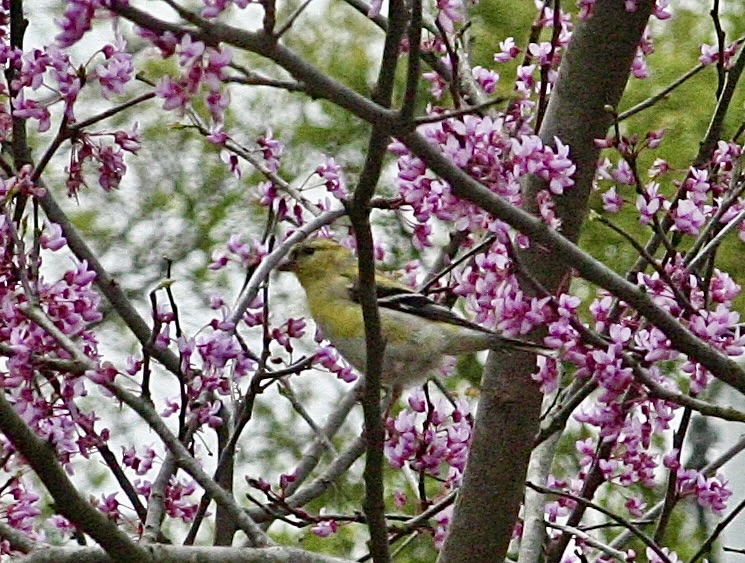
The redbud tree is in bloom and the American Goldfinch is beginning to bloom, too. This one is just beginning to show its summer colors. Soon it will be transformed into a much more brilliant yellow and black.

*~*~*~*

This year's Farm Bill could actually help some grassland species like the Bobolink that are in danger of disappearing from America's prairies.

*~*~*~*

The famous California mountain lion called P-22 was given a tribal burial this week in the mountains where he once roamed.

*~*~*~*

Spring is arriving about three weeks early throughout the continent. Trees, like my redbud, are already sprouting leaves and blooming.

*~*~*~*

A toxic algae bloom called the "red tide" is killing tons of fish along Florida's west coast.

*~*~*~*

This is the Dusky Tetraka, a songbird of Madagascar that had been thought to be extinct. It has been rediscovered by a team searching the tropical forests in the northeastern part of that country.

*~*~*~*

Have they been looking for life in all the wrong places? A European probe that launches next month will be scanning the moons of Jupiter for potential signs of life.

*~*~*~*

This winter in the northern hemisphere has featured some significantly weird weather. Is it all because of climate change or is there something else afoot?

*~*~*~*

It's not news of this planet but NASA's Mars rover, Curiosity, is sending back some very interesting pictures.

*~*~*~*

Here are our five grassland species of birds that are most in danger of disappearing.

*~*~*~*

Conservation organizations are dropping the name of John James Audubon in response to information about his white supremacist beliefs.

*~*~*~*

The python invasion of Florida no longer affects only the Everglades but extends into nearly all of the southern part of the state. 

*~*~*~*

Antarctica's sea ice is melting and that is bad news for Earth's land masses. 

*~*~*~*

This is the Gray-breasted Parakeet, the American Bird Conservancy's Bird of the Week.

*~*~*~*

To save Earth, we need to save Earth's seas. A new treaty may help to do that.

*~*~*~*

How we can best protect butterfly species becomes a legal question.

*~*~*~*

An explosion of seaweed growth in the Great Atlantic Sargassum Belt is visible from space.

*~*~*~*

What animal species are most in danger of going extinct? Scientists believe they know

*~*~*~*

The city of Pompeii was destroyed by a volcanic eruption in 79 A.D. and yet it lives on through the excavations of it. More and more is being revealed about life in the city. 

*~*~*~*

A coalition of groups is urging the Environmental Protection Agency to, in fact, protect the environment by reforming dangerous neonicotinoid pesticides

*~*~*~*

A majority of members of the United Nations have agreed on language for a treaty that would protect ocean biodiversity. 

*~*~*~*

A technique known as proteomics is used to analyze ancient human protein and it could unlock secrets of our species' evolution

*~*~*~*

A U.S. Forest Service logging plan that targets mature trees is angering residents in Kentucky.

*~*~*~*

Recent DNA discoveries reveal more of the history of the early hunter-gatherers who lived in Europe.

*~*~*~*

The plan for restoring bison to America's prairies focuses on expanding herds on Native American lands.

*~*~*~*

A creature called the sunflower sea star has been enlisted in the effort to control sea urchins in the kelp forests off the Pacific Coast of the continent.

*~*~*~*

One of the world's rarest populations of lions is in Senegal, but that population recently increased by three when a cat named Florence gave birth to three healthy cubs. 


Thursday, March 9, 2023

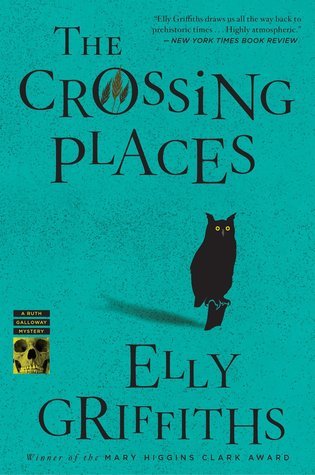
The Crossing Places by Elly Griffiths: A review


This is the first in Elly Griffiths' series of books featuring the forensic archaeologist Ruth Galloway. (Parenthetically, I once knew a woman named Ruth Galloway and I was curious to see if the fictional character would be anything like her. Answer: Only in being extremely intelligent and independent.)

This Ruth Galloway lives in a remote area of England near Norfolk called Saltmarsh. It is the area where the land meets the sea, a place that was sacred to the inhabitants who lived there during the Iron and Bronze Ages. Ruth is nearing forty, is single, and slightly overweight, and she lives with her two cats in a cottage on Saltmarsh.

Detective Chief Inspector Harry Nelson asks Galloway for her help when a child's bones are discovered on a nearby beach. He believes that the bones may be those of a child who went missing ten years earlier and he needs Galloway's help to determine their age. It turns out that they are actually two thousand years old, but Galloway's interest in the case of the missing child is piqued.

Since the child (named Lucy) disappeared ten years before, DCI Nelson has been receiving bizarre letters referencing her and speaking of ritual and sacrifice. Was Lucy sacrificed in some sort of pagan ritual? 

Then another child goes missing and the search intensifies to find the missing children and solve the mystery of their disappearance. Ruth Galloway is drawn into that search.

Galloway is also drawn to Harry Nelson and he is drawn to her, even though he is married. They bond over their mutual need to find out what has happened to the missing children. As the investigation progresses that bond grows stronger.  

Galloway's mentor Erik, as well as her ex-boyfriend Peter, and her friend Shona are also involved in Galloway's archaeological dig. The author's depiction of all the characters, most especially Galloway, is a strong point of the plot as is her description of the cold and desolate landscape where the action occurs.

This was an intriguing beginning for the series, a well-developed plot that drew me in and made me feel a part of the story. I liked Ruth Galloway quite a lot and I look forward to getting to know her better. Fortunately, there are several more entries in the series that will allow me to do that.


Tuesday, March 7, 2023

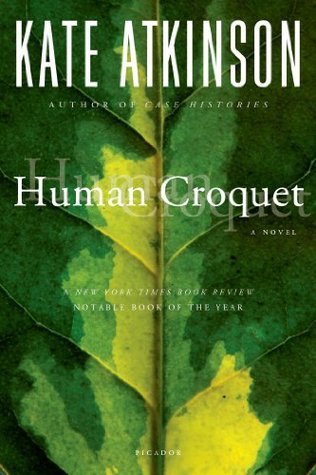
Human Croquet by Kate Atkinson: A review

Human Croquet is actually one of Kate Atkinson's early books. It was published in 1997. As such, I would rank it perhaps in the middle of her works as far as the quality of the plot and the writing. So, not one of her best but certainly not bad and well worth a read. (I don't think Kate Atkinson has ever written a bad book.) 

The book is set in a typical 1960s British suburb called Lythe. Lythe's claim to fame is that it was once the heart of an Elizabethan estate and was the home of a young writer/tutor named William Shakespeare. In the 1960s it was the home of a young girl named Isobel Fairfax. Human Croquet tells her story.

Isobel lives in a home with her quite dysfunctional family that includes a brother who is obsessed with alien abductions and an aunt who lives with many cats in her bedroom. Isobel's mother, Eliza, went missing when Isobel and her brother Charles were only children and they have never really recovered from this loss. Isobel's and Charles' father has remarried but the kids are not too keen on the new wife and Isobel, in particular, still harbors hope that her mother will someday return. 

Isobel is the narrator of the story and she has a wonderful voice. She is intelligent and witty but quite lonely and she had a profound longing for her mother which is central in her life. Isobel also has a very big crush, as only a teenager can, on a boy called Malcolm.

The mystery of Eliza's disappearance and Isobel's longing for her return dominate the story. We also get a good bit of Fairfax family history, along with Shakespearean references. And that would be my one complaint about the book; namely, that there is so much going on that it detracts somewhat from the main story. Nevertheless, Atkinson's depth of characterization and attention to detail are fully present and make for a book that is hard to put down and that the reader is sorry to see end.  


Sunday, March 5, 2023

A Slipping-down Life by Anne Tyler: a review


If I were to make a list of my favorite contemporary writers, Anne Tyler would be near the top. I haven't read all of her books, but I have read most of them and there's not a single one that I haven't enjoyed, some more than others, of course. 

This one would probably rate near the middle of the pack. It is actually one of her earlier ones, having been published in 1970. It just recently came to my attention that I had not read it, so I immediately set out to rectify that oversight.

A Slipping-down Life gives us the story of young Evie Decker. Evie is a lonely, shy teenager living in a small North Carolina town with her widowed father, a teacher.

There is nothing special about Evie. She's slightly plump and not especially attractive. There's really nothing to make her stand out or make people notice her. She doesn't have any particular talents or interests. But then she hears a rock singer named Drumstrings Casey being interviewed on a local radio station and she becomes obsessed with him.

She expresses that obsession in a truly weird way; she carves his last name (his first name is too long) into her forehead during one of his shows. At last, people begin to notice her! And her antics bring her to the attention of Casey himself. Her actions generate some publicity for him and the two develop a strange kind of symbiotic relationship.

Drumstrings (his actual name is Bertram!) is utterly self-absorbed. He is only nineteen and so both of these two characters are adolescents who are still feeling their way in the world. 

Tyler conveys quite well what a confusing time this is for these young people and the fact that they do things without really considering the consequences of their actions. I suppose in that sense this could be considered a coming-of-age novel. Evie, at least, has made a kind of transition by the end of the novel and is in a different, maybe better, place emotionally.

This really is a quiet little gem of a book, only 196 pages. The plot and the characters are so wonderfully developed by the author that one feels almost as though one is visiting with friends. Friends whom one sincerely wishes well. Oh, to be able to write like that!

Saturday, March 4, 2023

Poetry Sunday: Still I Rise by Maya Angelou

I have featured this poem here before. In fact, I have featured it more than once, but it is a favorite of mine and so here it is again! Enjoy. 

Still I Rise

by Maya Angelou

You may write me down in history
With your bitter, twisted lies,
You may trod me in the very dirt
But still, like dust, I'll rise.

Does my sassiness upset you?
Why are you beset with gloom?
’Cause I walk like I've got oil wells
Pumping in my living room.

Just like moons and like suns,
With the certainty of tides,
Just like hopes springing high,
Still I'll rise.

Did you want to see me broken?
Bowed head and lowered eyes?
Shoulders falling down like teardrops,
Weakened by my soulful cries?

Does my haughtiness offend you?
Don't you take it awful hard
’Cause I laugh like I've got gold mines
Diggin’ in my own backyard.

You may shoot me with your words,
You may cut me with your eyes,
You may kill me with your hatefulness,
But still, like air, I’ll rise.

Does my sexiness upset you?
Does it come as a surprise
That I dance like I've got diamonds
At the meeting of my thighs?

Out of the huts of history’s shame
I rise
Up from a past that’s rooted in pain
I rise
I'm a black ocean, leaping and wide,
Welling and swelling I bear in the tide.

Leaving behind nights of terror and fear
I rise
Into a daybreak that’s wondrously clear
I rise
Bringing the gifts that my ancestors gave,
I am the dream and the hope of the slave.
I rise
I rise
I rise.

Friday, March 3, 2023

This week in birds - #539

 A roundup of the week's news of birds and the environment:

This over-wintering Rufous Hummingbird appears to be giving me the evil eye.

*~*~*~*

There is an abundance of wind and solar energy projects set to go in the United States and yet they are running into serious delays as a result of antiquated systems.  

*~*~*~*

Incidents involving the accidental release of chemicals happen in the United States on an average of every two days.

*~*~*~*

Climate change is real and, as a result, parts of this country are seeing the earliest spring conditions on record.

*~*~*~*

The future of the great Okefenokee Swamp is being threatened by a plan to mine for titanium dioxide in the area.

*~*~*~*

Winter in northern climes brings drastic changes to the landscape. These pictures bear witness to those changes. 

*~*~*~*

One benefit of the Bipartisan Infrastructure Investment and Jobs Act signed by President Biden in 2021 is that it helps to reconnect habitats for freshwater and terrestrial animals.

*~*~*~*

A giant lacewing discovered at an Arkansas Walmart in 2012 turned out to be the first of its kind seen in eastern North America in more than fifty years. 

*~*~*~*

Sadly, a female Bald Eagle from the Mystic River Watershed has died after being brought to a wildlife center for treatment when she was discovered to be ill. She likely succumbed to rat poison found in the bodies of her prey. 

*~*~*~*

Raider ants, a parasitic variety, are freeloaders that seem to mimic queens.

*~*~*~*

A fatal fungus has been attacking the world's amphibians for a number of years now. A species of frog is now on the brink of extinction. Can science save it?

*~*~*~*
Flaco the Eurasian Eagle-owl, the former resident of the Central Park Zoo, is still free and likely to remain that way. He has proved that he is able to hunt and feed himself.

*~*~*~*

Fossils of the oldest known potential pollinator have been discovered in Russia near the village of Chekarda.

*~*~*~*

Twenty-three dead whales have washed up on the continent's east coast since December. What is causing these deaths?

*~*~*~*

In other news of whales, an unusual feeding technique used by them was documented in ancient texts as early as two thousand years ago.

*~*~*~*

This has been a week of continent-wide late winter storms

*~*~*~*


*~*~*~*

How do you successfully film wildlife? David Attenborough's camera wizards are the experts!

*~*~*~*

Logging in the Williamson's Sapsucker's old-growth forest home is further endangering an already endangered species.

*~*~*~*

One detrimental effect of the climate crisis facing the planet is an increase in human-wildlife conflicts

*~*~*~*

What is vocal fry and why do whales and dolphins use it in their communications?

*~*~*~*

The beautiful little Dickcissel is the American Bird Conservancy's Bird of the Week.